The Law That Just Handed Every Parent a New Playbook
Table of Contents
- Introduction
- What Australia’s Social Media Ban Actually Says
- Why This Law Matters to Parents Everywhere
- The Real Problems Social Media Creates for Children
- What the Research Really Says
- Parent Stories: What Families Are Experiencing
- Solutions That Actually Work for Families
- The Best Tools and Resources for Digital Parents
- Free Resources For Parents
Imagine sitting at the dinner table one evening, asking your 13-year-old about their day, and getting a one-word answer. Then watching them disappear to their bedroom, glued to a phone for the rest of the night. You hear the soft buzz of notifications, the faint scroll of a feed, and a quiet that does not feel like rest. It feels like something is being lost.
That scene plays out in millions of homes every single night. And for a long time, parents have been told to simply manage it. Set timers. Have conversations. Download an app. But deep down, many parents have wondered: Is this normal? Is this okay? And is anyone in charge actually doing something about it?
In November 2024, Australia answered that question with a bold, historic move. The Australian government passed the Online Safety Amendment (Social Media Minimum Age) Act 2024, making it the first country in the world to legally ban children under the age of 16 from using social media platforms. Not restrict. Not warn. Ban.
The reaction was immediate. Parents across Australia let out a collective sigh of relief. Critics raised concerns about enforcement. Tech companies pushed back. And parents worldwide, from Lagos to London, from Houston to Nairobi, started asking: Could this happen here? Should it happen here? And what do we do in the meantime?
This blog post is for every parent who has ever felt helpless in the face of a glowing screen. It breaks down exactly what Australia did, why it matters globally, what the research says, what real families are experiencing, and most importantly, what parents can do right now to protect their children, whether a law backs them up or not.
What Australia’s Social Media Ban Actually Says
The Australian law, which came into effect in early 2025, sets a strict age limit of 16 years for accessing social media platforms. This includes major platforms like TikTok, Instagram, Snapchat, Facebook, and X (formerly Twitter). The law places the burden of age verification on the platforms themselves, not on parents or children.
Platforms that fail to comply face fines of up to AUD 50 million (approximately USD 32 million). This is not a gentle nudge. It is a legally enforceable mandate backed by real financial consequences.
What the law covers:
- Children under 16 cannot create accounts on covered social media platforms
- Platforms must use age verification technology to enforce this
- Parental consent does NOT override the ban even with a parent’s permission, a child under 16 cannot join
- Existing accounts belonging to under-16s must be deactivated
- Educational platforms and messaging tools used for learning are generally exempt
Where to read the official law and government statements:
- Australian Government eSafety Commissioner: esafety.gov.au
- Australian Parliament House (Bill tracker): aph.gov.au
- ABC News Australia (coverage): abc.net.au/news
- Reuters Global Coverage: reuters.com
Why This Law Matters to Parents Everywhere
Even if you do not live in Australia, this law sends a message that echoes around the world: the era of letting platforms self-regulate when it comes to children is ending.
Countries including the UK, the United States, Canada, Norway, and several nations across Africa and Asia are already in active discussions about similar legislation. The UK’s Online Safety Act already places obligations on platforms, and the US has repeatedly attempted federal child online protection bills. The momentum is undeniable.
But here is the truth that parents need to hear: laws take time. Legislation moves slowly. In the meantime, millions of children are online every day, exposed to content and interactions that no parent fully controls. The Australian law is a landmark, but it is not a finish line. For parents around the world, it is a starting point.
What this law signals to parents globally:
- Governments are listening. The public pressure from parents, child psychologists, and health organizations has finally reached lawmaking bodies.
- Tech companies can be held accountable. When the stakes are high enough (AUD 50 million fines), platforms act. This shows regulation works.
- Children need adults to lead. Children cannot fully understand algorithmic manipulation, data harvesting, or addictive design. Adults must step in.
- The conversation has changed. This is no longer about whether social media is good or bad. It is about protecting child development during critical years.
Every parent, teacher, and caregiver worldwide can take this moment as permission to be more intentional, more proactive, and more confident in setting digital boundaries at home.
The Real Problems Social Media Creates for Children
To understand why a ban like this exists, parents need to understand the full picture of what unregulated social media does to young, developing minds. This is not about fear-mongering. It is about facts.
1. Mental Health and Anxiety
Social media platforms are designed to keep users engaged. For adults, this can be distracting. For children, whose brains are still developing, it can be damaging. The constant stream of curated, filtered, idealized images creates relentless social comparison. Children, especially girls between the ages of 10 and 15, are particularly vulnerable.
Studies published in journals like JAMA Paediatrics and The Lancet have repeatedly found links between high social media use and increased rates of anxiety, depression, and low self-esteem in children and teenagers.
2. Sleep Disruption
Screens emit blue light that suppresses melatonin, the hormone that helps the body prepare for sleep. When children use social media late at night, a habit that is extremely common, they fall asleep later, sleep fewer hours, and wake up more tired. Chronic sleep deprivation in children affects learning, memory, mood regulation, and physical health.
The American Academy of Sleep Medicine recommends no screens in the hour before bed for children. Yet surveys consistently show that the majority of teenagers sleep with their phones within arm’s reach.
3. Cyberbullying and Online Predators
Cyberbullying is relentless in a way that physical bullying never was. A child can be harassed 24 hours a day, seven days a week, with no safe space. It follows them home, into their bedroom, even into their sleep. The effects are serious. Cyberbullying has been linked to school avoidance, self-harm, and in severe cases, suicide.
Beyond peers, social media platforms also expose children to unknown adults. Predators use direct messages, group chats, and even comment sections to approach children. Many children are not equipped to recognize grooming behaviors, and the private nature of many online interactions makes it difficult for parents to notice.
4. Addictive Design and Dopamine Loops
Social media platforms use what neuroscientists call variable reward schedules, the same psychological mechanism used in slot machines. Every time a child opens their feed, they do not know what they will find. Sometimes it is exciting, sometimes it is boring. This unpredictability is precisely what makes it so hard to put down.
Children’s brains are still developing the prefrontal cortex, the part responsible for impulse control and decision-making. This makes them significantly more susceptible to addictive design patterns than adults.
5. Loss of Real-World Social Skills
When children spend hours each day communicating through screens, they miss out on the practice they need to develop real-world social skills. Reading facial expressions, navigating conflict in person, building empathy through shared physical experiences, these skills develop through practice. Screen time cannot replace them.
What the Research Really Says
The debate about children and screens is not new, but the research is becoming clearer and more urgent every year. Here is a summary of what leading researchers and organizations are finding:
Key Research Findings:
The World Health Organization recommends no screen time for children under 2, limited time for 3-4 year olds, and structured limits for older children.
A 2023 U.S. Surgeon General advisory described social media as a significant risk to the mental health of children and adolescents.
Research from the University of Oxford found that the relationship between social media and wellbeing is most harmful during ages 11-13 for girls and 14-15 for boys.
A study published in Nature Communications found that adolescents who used social media for more than 3 hours daily had double the risk of poor mental health outcomes.
Common Sense Media reports that 38% of children under 13 already use social media platforms despite existing age restrictions.
These findings are not from fringe sources. They come from peer-reviewed journals, global health organizations, and respected child development institutions. The science is pointing in one direction: children need boundaries around social media, and those boundaries need to be enforced.
Trusted research and resource websites for parents:
- Common Sense Media (commonsensemedia.org) Reviews platforms, apps, and content for age-appropriateness
- American Academy of Pediatrics (healthychildren.org) Guidance on screen time and digital health
- Child Mind Institute (childmind.org) Mental health resources for parents and educators
- Internet Matters (internetmatters.org) UK-based practical guides for online safety
- UNICEF (https://www.unicef.org/) Global child online protection resources
Parent Stories: What Families Are Experiencing
Research tells the big picture. But real parent stories show us what is happening behind closed doors.
“Our daughter was 12 when she got Instagram. Within six months, she was crying almost every night. She thought everyone else had a better life, better clothes, better friends. We did not connect it to the app at first. Looking back, it is so obvious.”
Parent from Melbourne, Australia
“The hardest part is that all his friends are on there. You do not want your child to feel left out. But we realized we were trading our child’s mental health for social acceptance. That is not a trade we were willing to make.”
Parent from Lagos, Nigeria
These are not isolated incidents. Pediatricians, school counselors, and child therapists across the world report a surge in anxiety, depression, sleep disorders, and social difficulties in children aged 10 to 17, and the timing consistently coincides with the rise of smartphone and social media use.
Solutions That Actually Work for Families
Whether a law protects your child or not, there are practical, proven strategies that parents worldwide are using right now. These are not about being the strictest parent on the block. They are about being an intentional one.
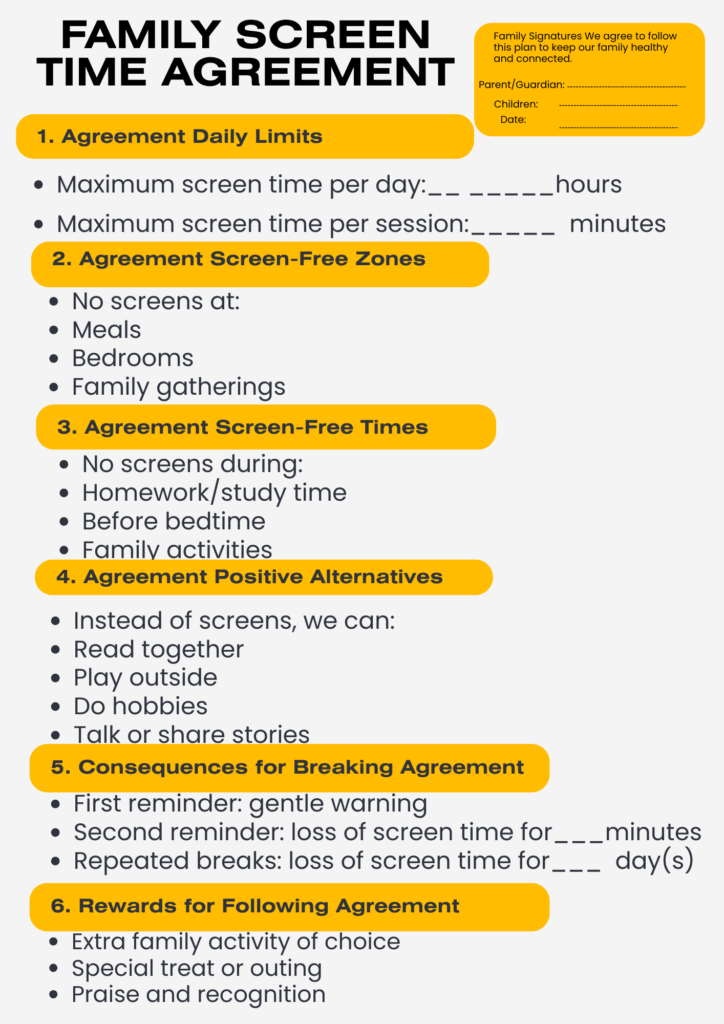
1. Start With a Family Screen Time Agreement
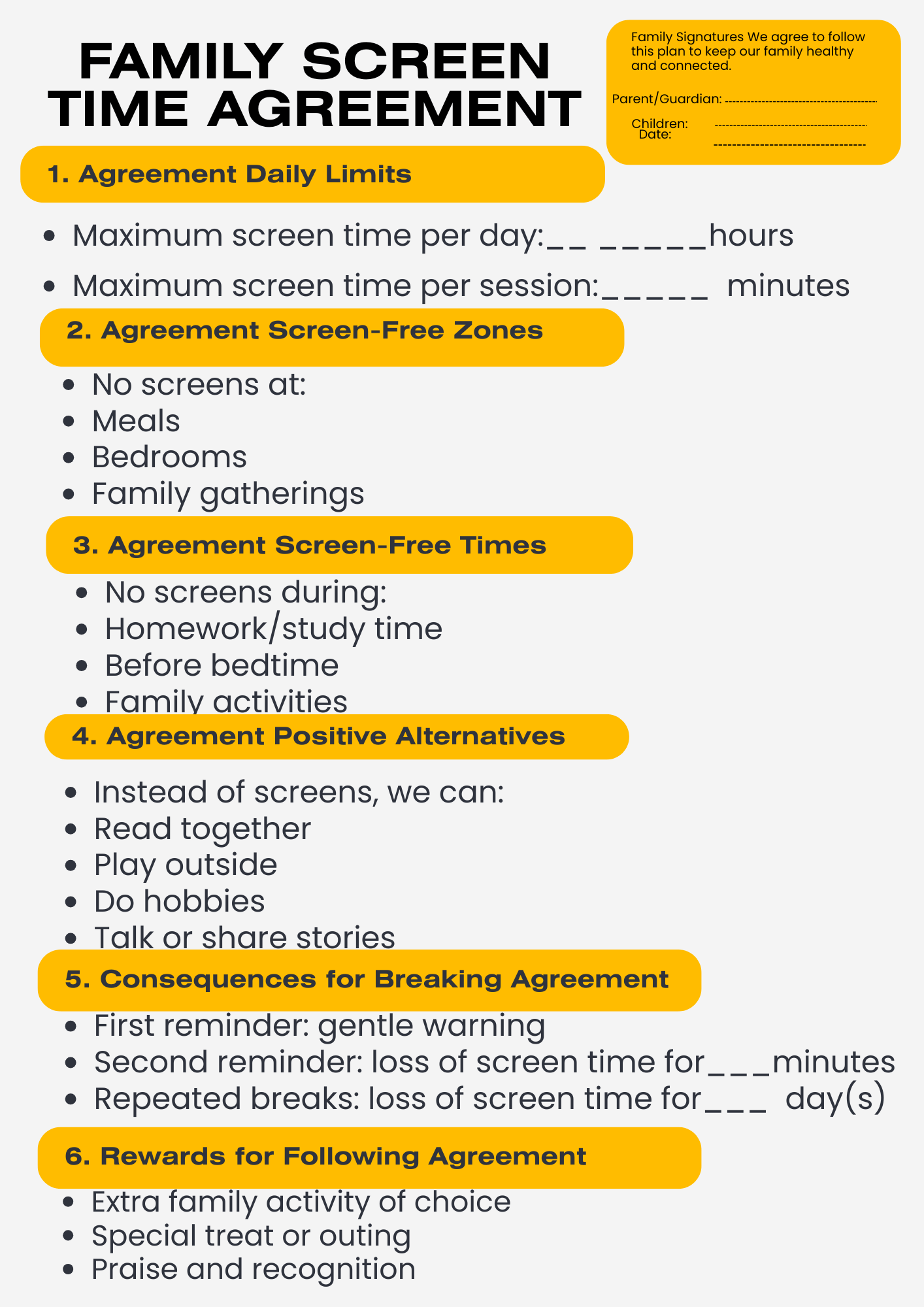
A Family Screen Time Agreement is a written set of expectations that every member of the household agrees to. It works because it removes the daily arguments and replaces them with a framework that was agreed upon in a calm moment.
What a good agreement includes:
- Agreed daily screen time limits for each child by age
- Screen-free times: mealtimes, one hour before bed, homework hours
- Screen-free zones: bedrooms, dining areas, places of worship
- Consequences for breaking the agreement (agreed in advance, not in anger)
- Parent commitments too: children respond better when they see adults modeling healthy screen habits
The American Academy of Pediatrics offers a free Family Media Plan tool at healthychildren.org/MediaUsePlan that families can customize.
2. Use Parental Controls and Monitoring Apps
Technology can be used to manage technology. There are now highly effective parental control tools that allow parents to set limits, block certain platforms, monitor online activity, and receive alerts if their child encounters something concerning.
Leading parental control tools currently available:
- Bark (bark.us): Monitors texts, emails, and social media for warning signs of cyberbullying, depression, and predators. Does not show parents everything, but alerts them to genuine concerns.
- Circle (meetcircle.com): Manages screen time across all devices on a home Wi-Fi network. Can pause internet access by device or by child.
- Qustodio (qustodio.com): Full-featured parental control app with detailed activity reports, time limits, and category blocking.
- Google Family Link (families.google.com): Free tool for Android devices that lets parents set content restrictions and daily limits.
- Apple Screen Time (apple.com): Built into iOS and MacOS, allows parents to set downtime, app limits, and content restrictions across Apple devices.
3. Have the Conversation, Not the Lecture
The fastest way to make a child defensive is to lecture them. The most effective way to change behavior is to have a genuine conversation. Ask open questions. Listen without judgment first. Share concerns without catastrophizing.
Try phrases like:
- “What do you like most about [platform]? What makes it fun for you?”
- “Have you ever seen anything on there that made you feel bad about yourself?”
- “What would you do if someone you did not know messaged you?”
- “How do you feel after spending a long time on the app?”
These conversations build trust. They also help children develop their own critical thinking about social media, which is a skill they will need for the rest of their lives.
4. Replace Screen Time With Connection Time
Children turn to screens partly out of boredom and partly because screens deliver immediate reward. The most effective long-term strategy is not simply removing screens but replacing screen time with activities that are genuinely enjoyable and social.
- Physical activity: Sports, dance, martial arts, and cycling all reduce anxiety and improve sleep, two of the biggest victims of excess screen time.
- Creative hobbies: Drawing, music, cooking, crafting, writing; these activities build focus, confidence, and a sense of identity that screens rarely provide.
- Family time: Board games, cooking together, weekend outings, even watching a film together as a family create the sense of belonging and connection that children seek online.
- Volunteering and community: Children who feel connected to a purpose greater than themselves are statistically less vulnerable to social media comparison and its mental health effects.
5. Model the Behaviour You Want to See
Children are watching. If adults scroll through their phone at the dinner table, check Instagram before bed, or reach for their phone the moment they wake up, children notice. The most powerful message a parent can send is their own behavior.
One research finding that surprises many parents: the number one predictor of a child’s screen time is not the child’s age or even peer influence. It is the parent’s own screen time.
The Best Tools and Resources for Digital Parents
Circle Home Plus
Circle is a device that connects to your home router and lets you manage internet access for every device on your network. Set daily time limits by family member, filter content categories, and pause the internet entirely with one tap. A favourite among parents with multiple devices across multiple children. Available for a one-time hardware purchase plus a low monthly subscription.

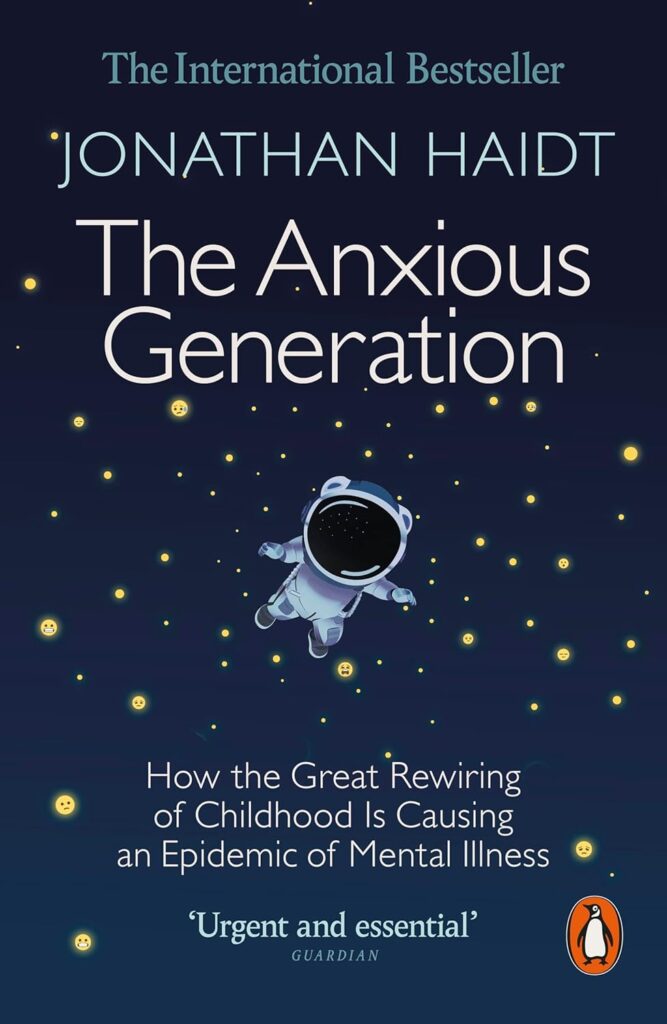
The Anxious Generation by Jonathan Haidt (Book)
Written by social psychologist Jonathan Haidt, this book examines how smartphones and social media are rewiring childhood and driving the mental health crisis among teens. It is one of the most referenced books in discussions around child online safety, and offers a compelling, evidence-backed argument for why society must rethink how children grow up in the digital age. Available on Amazon and in major bookstores.
Gabb Phone (Screen-Safe Starter Phone for Kids)
The Gabb Phone is a smartphone designed for children that removes social media, internet browsing, and in-app purchases entirely. It allows calls and texts only, giving children a communication tool without the risks of a full smartphone. Ideal for children 8-13 who need a phone for safety but are not ready for social media access.

Qustodio Premium Parental Controls
Qustodio is one of the most comprehensive parental control apps available. It provides screen time reports, app usage history, web filtering, location tracking, and the ability to block specific apps like TikTok or Instagram. Available for iOS, Android, Windows, Mac, and Chromebook. Premium plans cover up to 15 devices.
Free Resources For Parents
Because every parent deserves tools, not just information, here are free resources you can use, share, and download today.
Family Screen Time Agreement Template
A printable, fillable agreement your family can customize and sign together. Includes sections for daily limits, screen-free zones, and consequences.
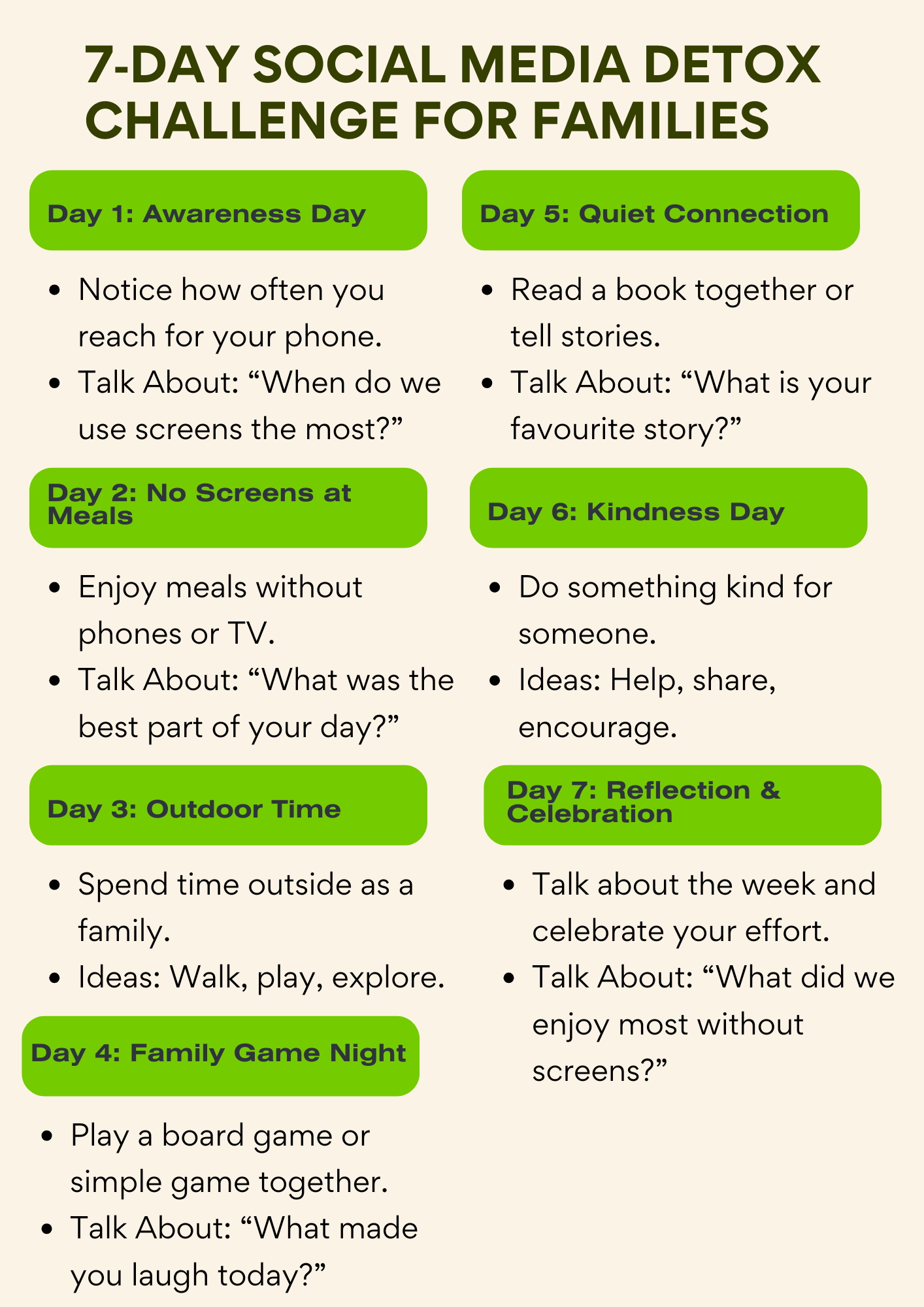
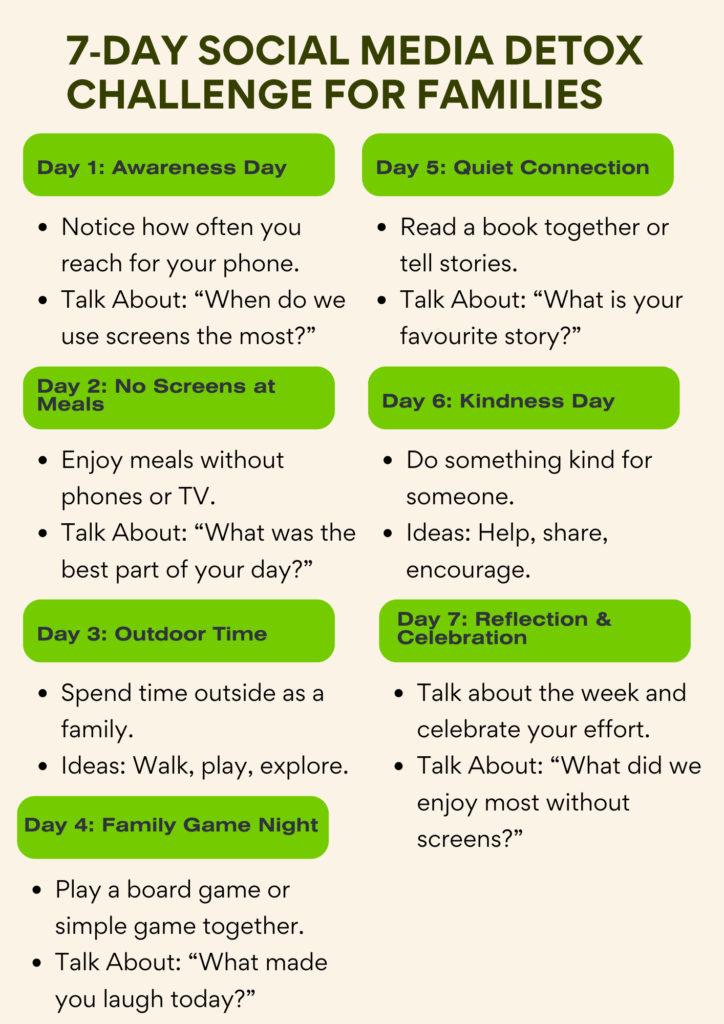
7-Day Social Media Detox Challenge for Families
A day-by-day family challenge that replaces screen time with connection activities. Includes conversation prompts and family activity ideas.
A Final Word to Parents
Australia’s social media ban is a beginning, not a conclusion. It is proof that when the evidence is strong enough and the voices are loud enough, change is possible. But children cannot wait for every government in the world to catch up with reality.
The most powerful thing standing between a child and the harms of unregulated social media is not a law. It is an informed, engaged, and courageous parent who is willing to have hard conversations, set clear boundaries, and prioritize a child’s wellbeing over momentary peace.
That parent can be any one of us. It starts today. Share this post with a parent who needs to see it. Start one conversation this week. Set one boundary this month. The small steps, taken consistently, are what change lives.